Technical electrical reports

Electrical inspection report with measurement, evidence and ART record

A document the fire marshal accepts, the insurer recognises and the utility files. Every statement has a reading, a photo and a standard behind it — and every non-conformity arrives with the fix path and an estimated cost.

Installation report LPS and earthing Thermography ART included
Report types

Choose by the document you must file

Before quoting I ask one thing: who will read the report? The scope follows the requirement of the receiving body, not a generic template.

Installation condition report

Overall compliance assessment against NBR 5410: boards, circuits, protection, conductors, sockets and earthing. Basis for AVCB, occupancy permit, financing and commercial leasing.

  • Average 5 business days
  • ART included
  • Non-conformity list

Lightning protection and earthing

Verification of air terminals, down conductors, earth electrode system, bonding and continuity per NBR 5419, with field measurement of earth resistance.

  • Megohmmeter + earth tester
  • Earth grid sketch
  • Common fire marshal request

Infrared thermography survey

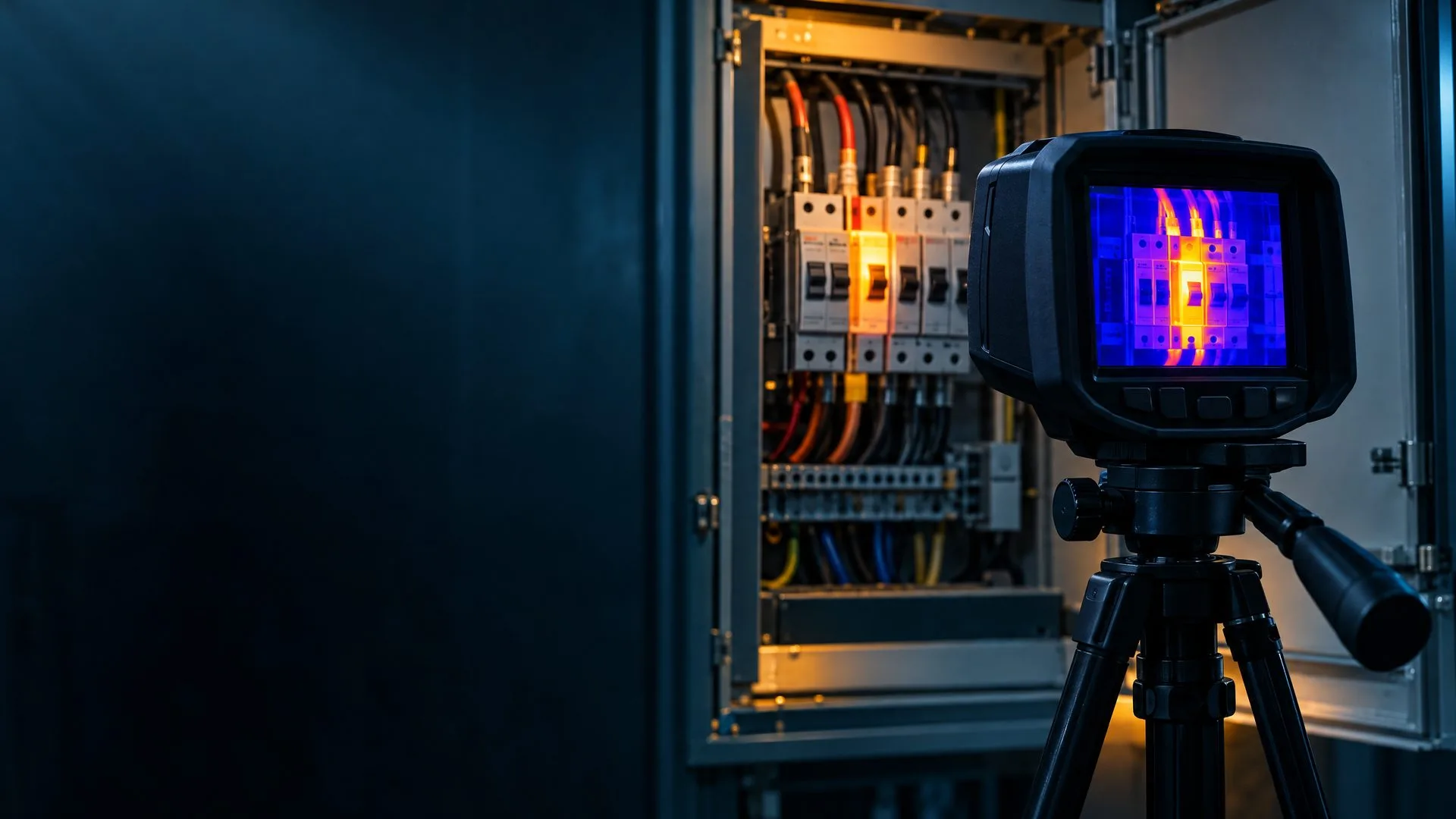
Hot-spot detection in boards, busbars, connections and motors under real load, with thermal image, temperature and criticality grading.

  • Emissivity-calibrated records
  • Ranked by risk
  • Report per circuit

Energy audit

Demand, power factor, time-of-use profile and power quality readings to support the savings plan or an investment case.

  • Cross-checked with your bill
  • Payback per action
  • ESG target basis

Sale, insurance or estate report

Documents the state of the installation for an insurance policy, probate, property purchase or construction credit release.

  • Accepted by correspondents
  • Dated photographs
  • Signed PDF delivery

Post-incident opinion

Investigation of burn-out, short circuit or smouldering fire: probable sequence, technical cause and what must change to prevent a repeat.

  • Urgent survey available
  • Hypotheses tested
  • Expert-witness support
How the report is produced

From site survey to filable document

A report without testing is an opinion. That is why the method starts with an instrument in hand.

Scope and scheduling

Alignment on the receiving body, existing paperwork and survey date. I send the list of what you need to gather.

1 day

Survey and testing

Visual inspection, continuity and insulation resistance measurement, RCD verification, current and voltage per circuit, thermography of critical points.

1 day on site

Analysis and grading

Comparison with the standard, risk grading (critical, high, medium, low) and cost estimate per corrective item.

2 to 3 days

Issue and ART

Signed report, ART filed with the council and files ready for submission — digital and printed if you need it.

1 day

After-service

Clarification for the electrician doing the repairs and a free re-test of corrected items within 30 days.

included
Document content

What the report contains

A report standard accepted by fire brigades, insurers and technical audits.

Report structure

  • Technical lead identification, qualifications and ART number
  • Object, installation address and purpose of the document
  • Standards and legal requirements adopted as reference
  • Methodology, instruments used and calibration status
  • Dated photographic survey, circuit by circuit
  • Test schedule with measured values and normative limit
  • Thermography map with temperatures and colour scales
  • Non-conformity list classified by risk
  • Correction plan with priority and estimated cost
  • Technical conclusion and signature with seal

What a report is not

It is not an automatic certificate nor a permanent safety warranty: it attests the conditions found on the survey date. Items fixed after issue may need re-verification — which is why the correction plan comes with it.

Validity questions

References

Standards used in testing

Every requirement in the report points to the matching clause.
Document What it demands Corresponding test
NBR 5410 Safe and correctly sized low voltage installation Visual inspection, protective conductor continuity, insulation resistance, RCD trip test
NBR 5419 Lightning protection system Down-conductor continuity, earth resistance, bonding
NBR 14039 Medium voltage installations Switchgear inspection, clearances, switching and earthing
NR-10 Worker safety in electrical installations Installation documentation, de-energisation, signage
Fire brigade IT AVCB/CLCB renewal Report with ART, thermography and closed non-conformities
Utility requirements Service entrance and metering Enclosure, recloser, CT/PT and delivery point check

Insulation resistance and continuity tests are performed de-energised and locked out, following the NR-10 safety procedure.

Technician performing a thermographic inspection on an industrial switchboard Free re-test within 30 days
After the report

A report that stays useful during the fix

Delivering the PDF is half the job. The other half is making sure the non-conformity list fits the maintenance budget and calendar — prioritised by risk, not by page order.

  • Item-by-item correction budget with specified material
  • Phased execution by priority when cash is limited
  • Coordination with planned production shutdowns
  • Document re-issue after critical items are closed
  • Follow-up with the inspecting authority until approval

Frequently asked questions

How long does the report take?
The survey is one day on site and the document ships in an average of 5 business days. Installations above 200 circuits or with extensive lightning protection may take up to 10 business days. Urgent cases (a booked fire brigade inspection) are prioritised.
Do I need to shut the power off?
Some tests — continuity and insulation resistance — require the installation de-energised and locked out. Thermography needs real load, so it is done live. Planning with your maintenance team avoids unnecessary downtime.
Does the report guarantee the inspection will pass?
The report attests the conditions on the survey date and states what must be corrected. If there is a non-conformity it has to be resolved before the fire brigade signs off — and the correction plan is included so this happens fast.
Is it valid in any state?
Yes. The report follows Brazilian technical standards, which are national, and the ART record is accepted countrywide. State-specific fire brigade instructions are taken into account when writing it.
What if I already hold an old report?
I review the existing document before charging for a new survey. In many cases the previous report only needs supplementary testing, which lowers the cost.

What an electrical inspection report must actually contain

A report accepted by a public body has four elements that cannot be missing: identification of the qualified technical lead with an ART tied to the object, explicit reference to the standards applied, record of measured values with the instruments used, and a clear conclusion. Reports that merely state the installation "complies" — without a test schedule — are usually returned during review.

The second most common cause of rejection is a mismatch between the ART object and the requirement of the receiving body. An installation report does not replace a lightning protection report, and a design opinion is not a condition report. That is why I always start by asking which document must be filed and where.

A realistic schedule when an inspection is already booked

  1. Confirm the authority, the deadline and the applicable technical instruction
  2. Schedule the survey at least three business days ahead
  3. Close critical items immediately after the report is issued
  4. Targeted re-tests and re-issue with compliance notes
  5. File the updated document with the fire brigade
Talk to the technical lead

Let us size your savings before the design is signed off

Typical reply within 4 business hours · Worldwide from Brazil

WhatsApp Telegram Send e-mail Quote