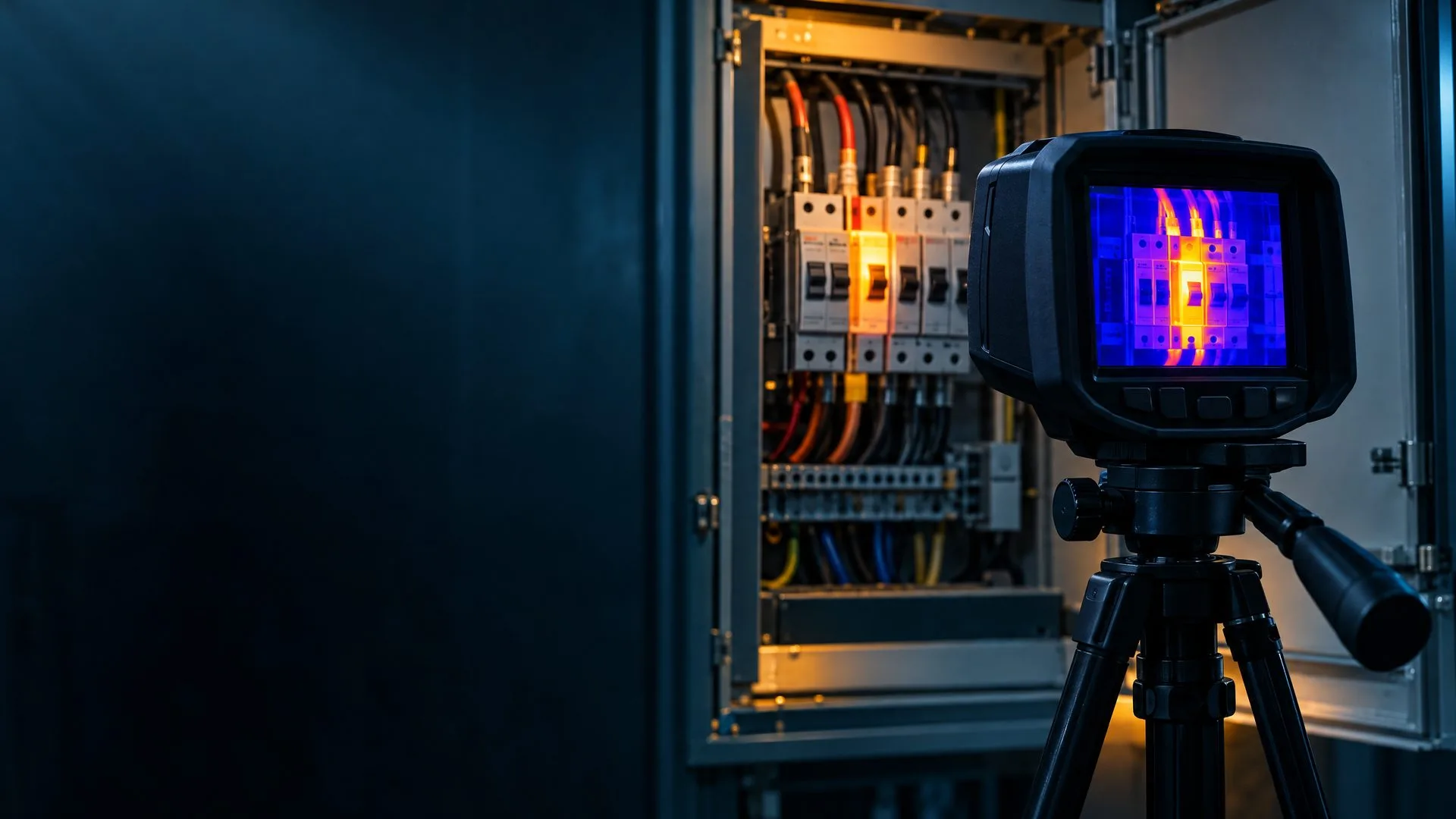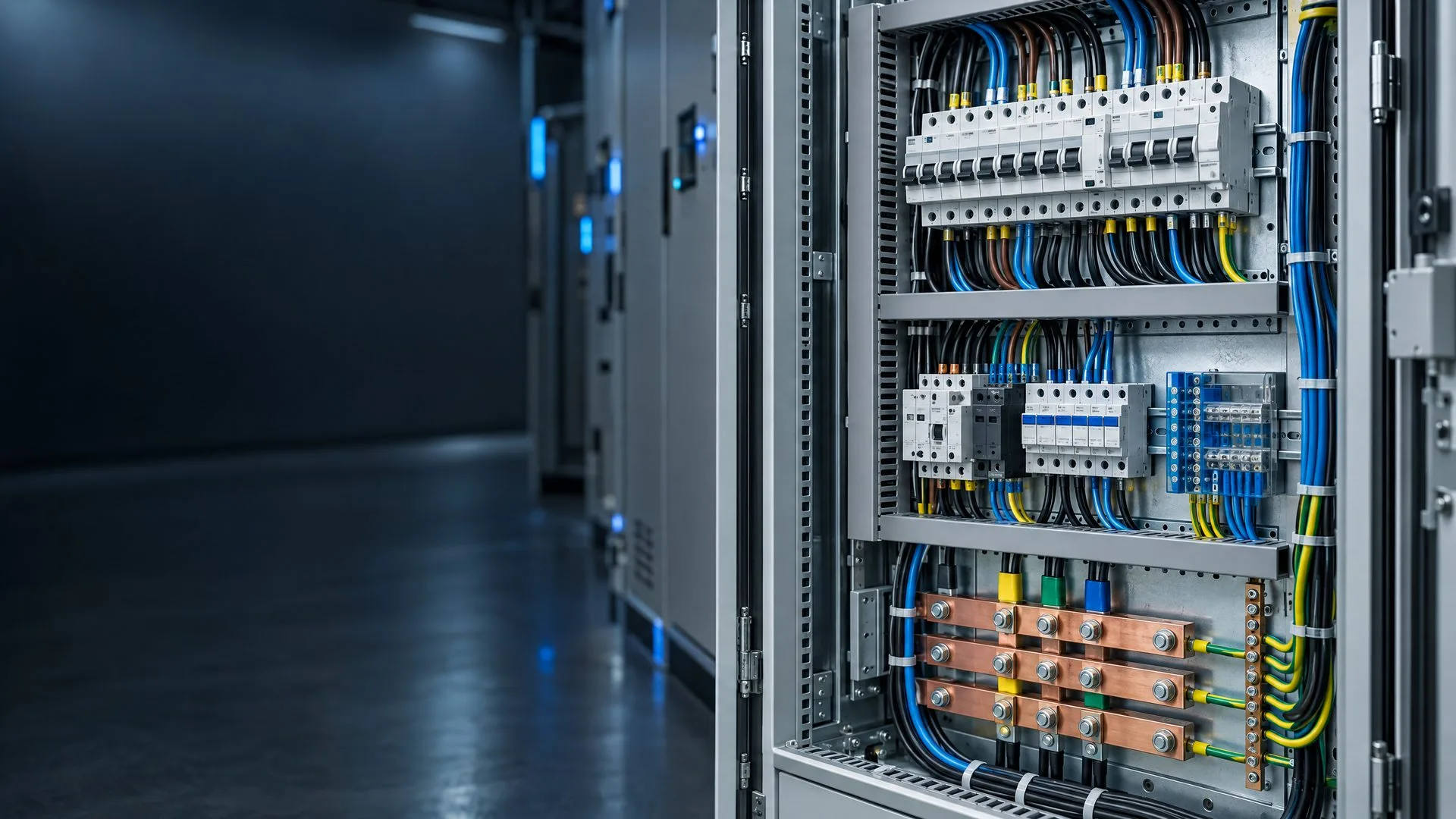
Your power bill is settled before any equipment is switched on: it is decided on the drawing board. After more than a decade designing residential, commercial and industrial boards I keep seeing the same pattern — the buildings that save money are not the ones with the priciest breaker, but the ones that got seven design decisions right.
Two of them change losses inside the building; the other five prevent rework, misuse and quiet waste. Every one is taken by somebody — designer, electrician or owner. If nobody takes it, the lowest material quote does, and that is the worst outcome.
1. A load forecast with real numbers, not table values
Installed load is not demand. Add up every nameplate and you get a number that never happens simultaneously. I work from density per use (W/m²), consumer units per room, nameplate ratings of the large equipment and a justified diversity factor — a bakery is one thing, a clinic another, a shop with central air conditioning a third.
- List what genuinely exists: equipment with its plate, when it runs, who switches what on;
- Set aside capacity for growth — a kitchen that may become an industrial kitchen, a room that becomes a server room;
- Separate fixed load from occasional load, because fixed load is what pays for cable and transformer;
- When the building already exists, read historical demand off the bill: measured numbers beat estimates.
The mistake has two faces. Too tight and the board trips, which the owner solves with a bigger breaker, which heats the cable. Too loose and the client pays for oversized copper and protection while gaining nothing on the bill.
2. Conductor sizing driven by voltage drop as well
NBR 5410 requires the conductor to be checked for current capacity, overload, short circuit and voltage drop. In day-to-day design work it is voltage drop that decides long runs and high-current circuits.
Conductor loss is proportional to the square of current: P = R x I². Double the current, quadruple the loss. That is why I insist on three habits: shorten the conduit route before upsizing the cable, balance single-phase circuits across phases, and hold a tight internal voltage-drop limit on final circuits — commonly 3% to 4%, which repays the extra copper through avoided loss over the years.
3. Discrimination without paying extra for it
Discrimination means that when something fails only the affected circuit opens, not the main switch. In a shop a tripped main closes the checkout; in an office it drops the server. It is solved with the right tripping curve (B for resistive load, C for lighting and ordinary inductive load, D for motors and capacitor banks), proper coordination between devices and, where needed, a checked short-circuit current at the furthest point.
The effect on the bill is indirect but real: a board without discrimination becomes a bigger-breaker improvisation, which becomes oversized cable in the retrofit, which becomes protection out of adjustment. And in motors, an uncoordined starting peak means heating in the winding and a shorter life.
4. Power factor and harmonics
Motors, pumps, air conditioners and old magnetic-ballast luminaires pull reactive current. It looks like the same power, but the conductor heats, the transformer works harder and the utility notices: for group A tariffs, reactive excess becomes a line-item charge when the average power factor falls below the reference; residential group B is normally not charged for it, yet the oversizing it forces is still paid by the client.
Correction is designed, not improvised: switched capacitor banks, drives with DC-link chokes, filters when harmonic distortion is material. Non-linear loads — cheap LED drivers, UPS units, switch-mode supplies — stack triplen harmonics in the neutral, so in electronics-heavy buildings I specify a neutral the same size as the phase conductors and check the extra heating in the conductors.
5. Phase balance
In a three-phase building, spreading single-phase circuits is a design decision, not an installation decision. Unbalanced phases raise neutral current, add loss, sag the voltage on the loaded phase and make motors vibrate. Getting it right costs one afternoon of drawing and zero material; rebalancing an existing board later costs the electrician a full day and the building manager whatever is left of the common-area cost split.
6. Dedicated circuits and a board with spare capacity
Shower, air conditioner, oven, pump, freezer, EV charger: each deserves its own circuit, with protection, conduit and outlet sized for it. Shared circuits are the reason a building gets rewired two years after handover.
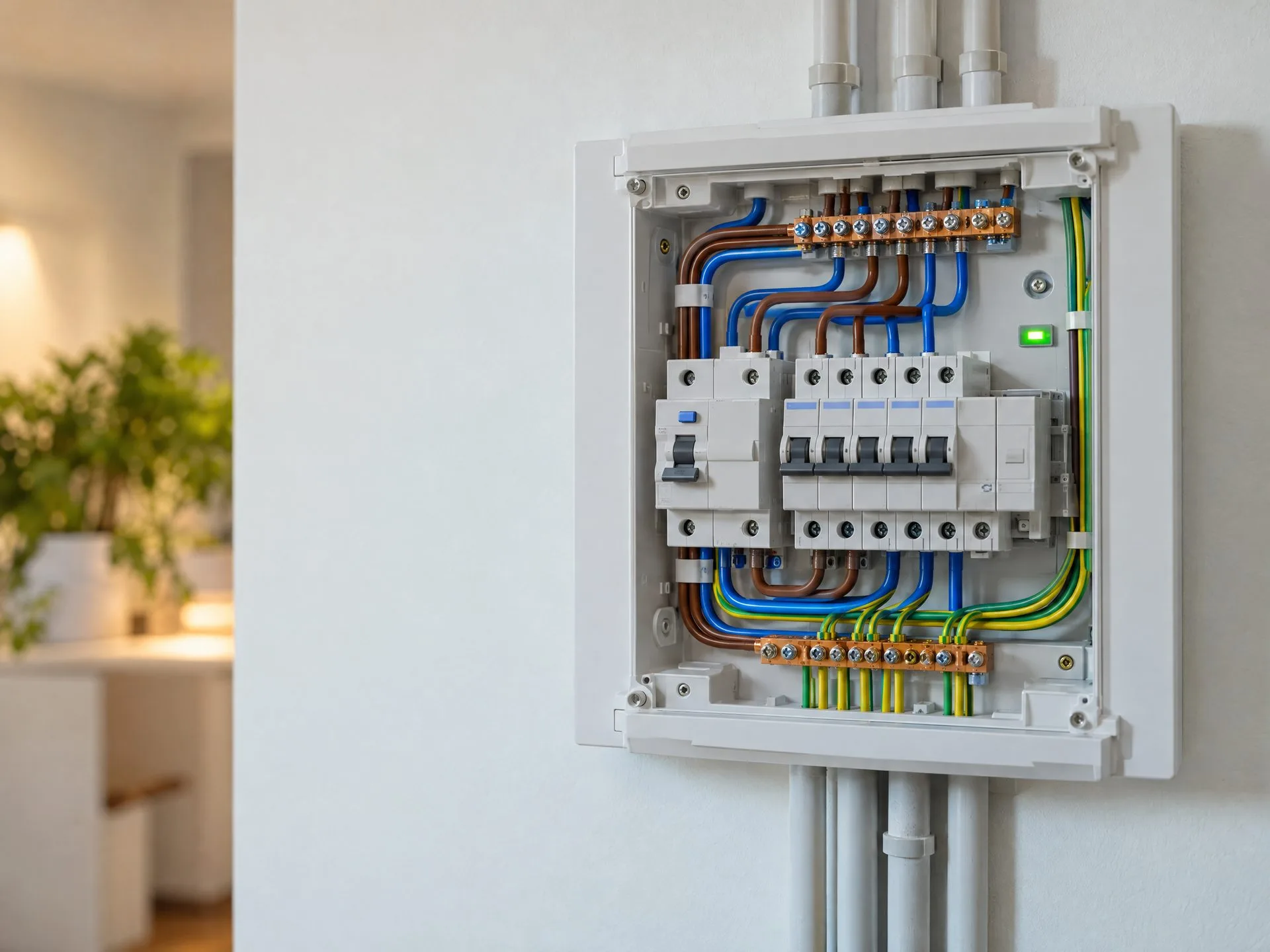
In the board I keep space and busbar for what has not been bought yet — as a rule of thumb 20% to 25% free module slots, and a main breaker with at least one current step of headroom. A board full on delivery day guarantees improvisation the first summer.
7. LED lighting with control, zoning and the right level
LED is the starting point, not the saving. The saving comes from three things: illuminance matched to the task (no overshoot, which the lighting standard handles room by room), control — occupancy, schedules, dimming, zoning — and optical design that uses daylight. Replacing luminaires while leaving the switching untouched keeps the old habit of turning everything on, and in a high-bay warehouse maintenance is usually worth more than the lamp swap.
The eighth decision: planning for solar and an EV
This one is about construction, not about the bill. If there is any chance of photovoltaic panels or an EV charger in the coming years, the design must fix four points: an empty conduit from board to roof, headroom in the main breaker, space in the board for the generation incomer, and for the charger a dedicated circuit with the right RCD and a conductor sized for long hours of continuous current.
Empty conduit costs cents per metre during construction. Opening a wall afterwards, surface-running cable and swapping the board costs a week of the building being out of use. That is why the green energy page starts with a feasibility study rather than a panel catalogue.
The seven decisions in one table
| Decision | What it fixes | What shows up on the bill |
|---|---|---|
| Load forecast | Supply capacity, main breaker, transformer | Contracted demand and badly paid reserve |
| Conductor size | Losses inside the building and heating | Invisible monthly loss on long runs |
| Discrimination | Operational comfort and safety | Rework, patching and burnt motors |
| Power factor | Reactive current and installed capacity | Reactive charge in group A, extra copper always |
| Phase balance | Neutral current and voltage per phase | Added loss and equipment under stress |
| Dedicated circuits | Future works and correct protection | Expensive retrofit and nuisance tripping |
| Lighting with control | Lit hours per zone | Consumption nobody noticed they were paying |
The power bill is not luck and it is not the tariff: it is the board layout, the load distribution and how the lights are switched. Design it well and the talk about miracles stops.
If you are deciding between rebuilding the board and rewiring circuits, start with diagnosis: the electrical design page shows what I deliver, and energy savings shows where to measure before spending. For a fixed number on your case, the quote form answers within 4 business hours.
What to take away
- Installed load is not demand: use density per use, justified diversity and the historical bill as reference.
- Choose conductors for voltage drop as much as for ampacity: loss grows with the square of current.
- Power factor, phase balance and discrimination are cheap design corrections with a lasting tariff effect.
- Every significant load wants its own circuit; keep 20% to 25% free module slots in the board.
- Planning for solar and EV charging today is the cheapest work you will ever do on those subjects.
Technical lead
Julio C. Fornazier
Leading Energia Criativa, Julio signs low and medium voltage electrical designs, technical inspection reports and energy efficiency plans for industrial, commercial, condominium and residential clients across Brazil. His method is simple: measure before specifying, simplify the circuit, cut waste and deliver the full documentation needed for utility approval, fire marshal audits and inspections.